Are you looking to sell your business? Discover how the contribution-sale (scheme 150-0 B) ter works and the main reinvestment strategies to optimize your taxation.
Optimize reinvestment after the sale of your business through the contribution-sale scheme (150-0 B ter)
Selling a business is a pivotal moment in a manager's life. It allows them to realize years of work, but it also often comes with significant taxation on the capital gain.
To address this challenge, the legislator has provided a particularly structuring mechanism: the so-called " 150-0 B ter This is often referred to as a contribution-sale. When properly planned, this mechanism not only allows for the deferral of taxation, but also for the redirection of capital from the sale towards new investment projects.
Discover also Millennium Invest's overall approach to structure your strategy after a sale.
Contribution-sale (150-0 B ter): a lever to defer taxation
The principle of contribution-sale
The mechanism is based on a two-step process. Before the sale, the manager contributes the shares of his company to a holding company he controls. This contribution does not, at this stage, trigger immediate taxation of the capital gain: it is deferred.
Subsequently, the holding company sells the contributed shares. The proceeds from the sale are then received by this entity, allowing the business owner to retain greater reinvestment capacity. However, this tax deferral is only maintained if several conditions are met.
An economic logic encouraged by the State
The intent of the text is clear: it is not merely a tax optimization tool, but a mechanism designed to promote the reinvestment of entrepreneurial capital in the real economy. The scheme thus aims to encourage selling business owners to finance new activities, support other companies, or participate in new development projects.
Conditions to be met to retain the tax deferral
A reinvestment obligation
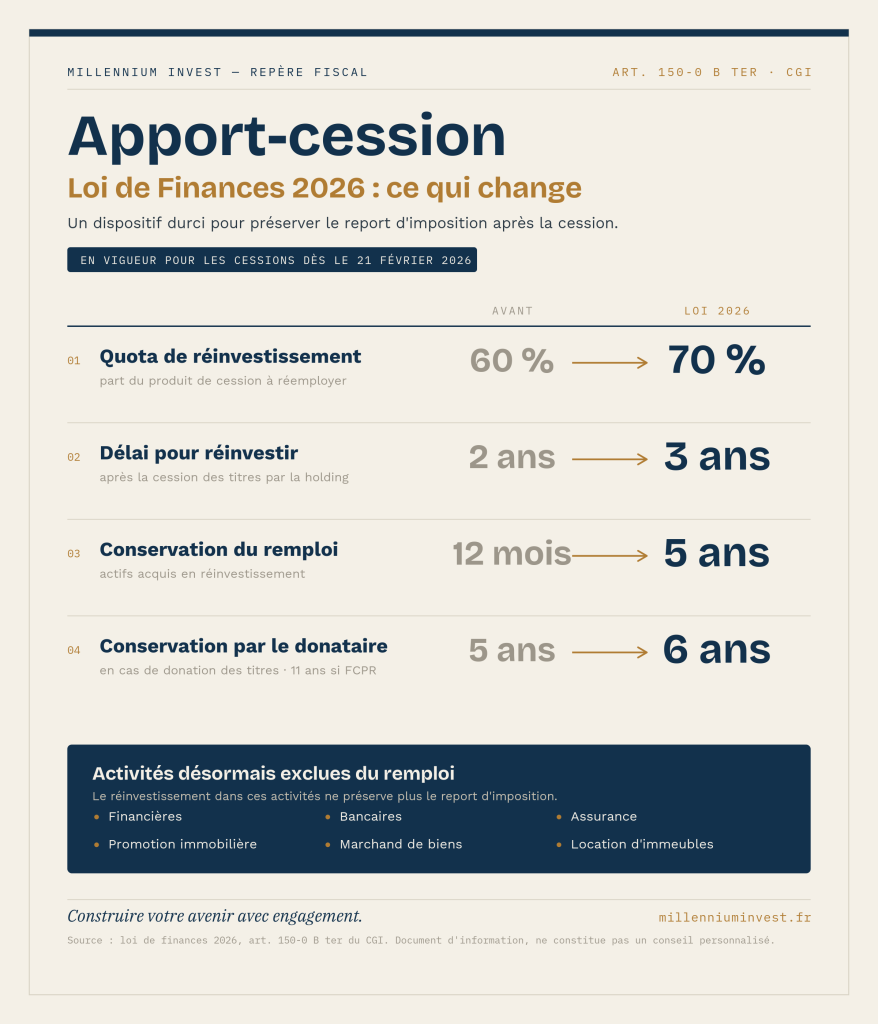
When the holding company sells its shares within three years of the contribution, the company receiving the contribution must reinvest a significant portion of the proceeds. In practice, it must reinvest at least 70% of these proceeds within three years. This reinvestment requirement is what allows the tax deferral to be maintained.
Investments geared towards economic activity
Reinvestment must be directed towards activities that serve a genuine economic purpose. This primarily includes commercial, industrial, craft, agricultural, and professional activities, as well as equity investments in operating companies. Conversely, purely asset-based investments, particularly those based on the passive holding of assets, generally do not align with the spirit of the legislation.
For further information, see Our services in financial management and wealth structuring.
The central role of the holding company
In this model, the holding company is not limited to a purely technical function. It becomes a true asset management tool. It receives the proceeds from the sale, organizes reinvestments, and allows the manager to structure their long-term strategy. When well-designed, it offers a flexible and coherent management framework to support the post-sale period.
Why structure your reinvestment after a sale?
Moving from a concentrated heritage to a diversified heritage
Before the sale, a business owner's assets are often heavily concentrated in a single asset: their company. The sale therefore represents a pivotal moment, allowing them to transform this concentration into a more balanced allocation. The stakes are not only tax-related; they are also about wealth management. The aim is to secure a portion of the capital, diversify sources of income, and reduce dependence on a single economic risk.
Change your mindset and think like an investor
After a sale, business owners often enter a new phase. It's no longer just about managing a business, but about defining an investment strategy consistent with their personal, family, and wealth management objectives. This requires balancing the pursuit of performance, the need for liquidity, the investment horizon, and the acceptable level of risk. The 150-0 B ter provision becomes particularly relevant during this transition.
Discover dedicated support for business leaders Proposed by Millennium Invest.
What concrete solutions exist for reinvesting through a contribution-sale?
Reinvestment can take many forms. In practice, the strongest strategies rarely rely on a single asset class. They often combine several approaches to achieve a balance of appreciation potential, diversification, and long-term visibility.
Investing in unlisted companies
Private equity is one of the most natural pathways within a capital contribution and sale structure. It allows investment in SMEs or mid-sized companies, supporting growing businesses and, sometimes, leveraging one's own entrepreneurial experience. This solution is particularly appealing to executives who wish to remain close to the real economy and maintain an active, even indirect, role in value creation.
Going through investment funds
Using specialized funds allows for more immediate diversification. This approach is often appreciated by investors who wish to delegate the selection of investment opportunities to professional teams and spread the risk across multiple holdings. It also provides exposure to opportunities that are sometimes difficult to identify or negotiate independently.
Develop a real estate strategy with an operational dimension
Real estate is not necessarily excluded from the realm of relevant reinvestments, provided it is considered from an economic rather than a wealth-building perspective. The key distinction lies in the difference between simply owning property and investing in an operational business that generates revenue and services.
The hotel industry
The hotel industry provides a particularly compelling example. Investing in a company that operates a hotel, finances its renovation, or develops an accommodation concept with genuine commercial activity can be a logical step within this framework. This type of investment has the advantage of being based on an identifiable business, with revenues linked to operations and potential for appreciation based on the quality of the asset, operational management, and the attractiveness of the location.
Managed residences and para-hotel models
Similarly, certain serviced residence, coliving, or aparthotel models can be promising avenues, provided they are based on genuine operational services. This point is crucial: it is not the real estate asset itself that determines the viability of reinvestment, but rather the existence of real economic activity surrounding that asset.
Taking over a company or becoming an active shareholder
Some business owners who are selling their companies also choose to reinvest by acquiring a new company or taking a significant stake in an existing one. This option allows them to extend their entrepreneurial momentum while leveraging their experience in a new project. It often appeals to those who wish to maintain close ties with day-to-day operations while benefiting from a structured investment framework.
Build a coherent allocation
In practice, a sound reinvestment strategy often relies on balance. Part of the capital can be allocated to dynamic assets with strong growth potential, such as unlisted investments. Another part can aim for greater diversification or visibility through specialized funds or income-generating activities. The challenge lies in building a coherent portfolio tailored to the investor's profile and their medium- and long-term objectives.
Turning a sale into a wealth management opportunity
The 150-0 B ter scheme should not be viewed as a simple tax mechanism. It is primarily a tool for wealth transformation, enabling the conversion of proceeds from a sale into a structured, diversified, and evolving investment strategy.
However, it is essential to understand the rules, select the appropriate investment vehicles, and align investment choices with the manager's personal objectives. In practice, the success of such an operation depends as much on the quality of the structuring as on the suitability of the assets chosen.
Are you considering a sale or a reinvestment? Our experts will help you structure a strategy tailored to your wealth management objectives.
👉 Take stock with an expert wealth management consultant by making an appointment on our website.